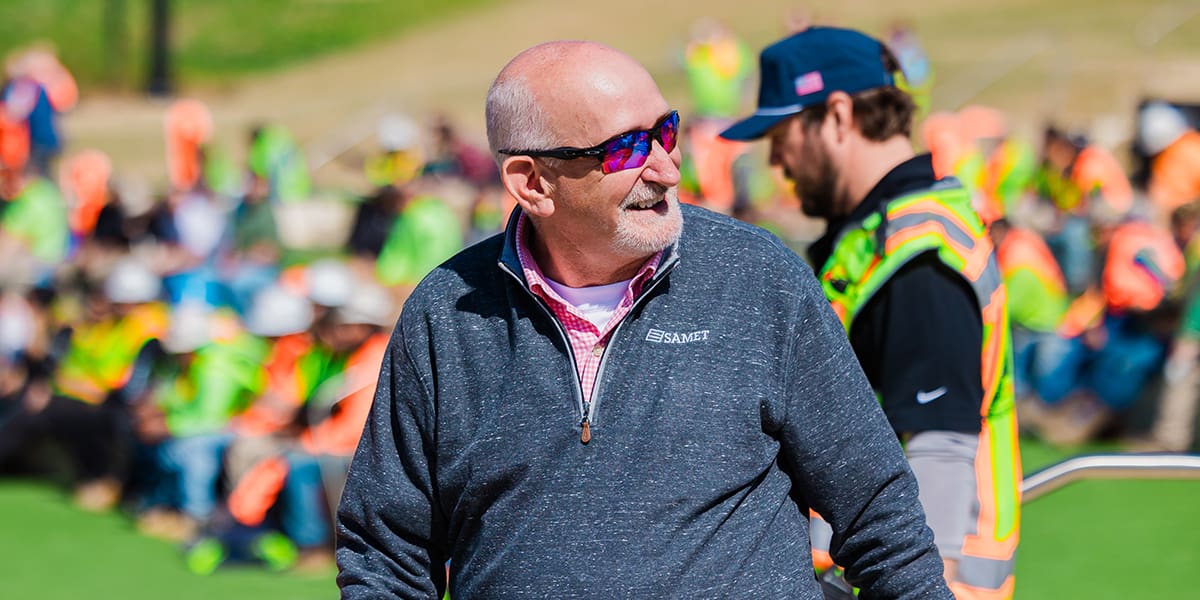
Alton Tew Reflects on His 46 Years in Construction
From the Beginning
It’s 10 p.m. on a sweltering August night in Raleigh, and Alton Tew is cutting sheetrock behind a dryer. Water’s leaking, students move in tomorrow, and the project that’s consumed the last several months of his life hangs in the balance. Next to him, Rick—Samet’s president—is helping him patch the hole they’ve just cut. Five hours later, they’ll turn the keys over five days early.
“The projects you remember aren’t always your biggest wins,” Alton reflects now, months later and weeks away from retirement. “Sometimes they’re the ones where you’re shoulder-to-shoulder with your team at 10 p.m., doing whatever it takes to get it done.”
After 46 years in construction—24 of them with Samet—Alton Tew is hanging up his hard hat. But if you know Alton, you know his story isn’t measured in years or even in the thousands of units he’s helped deliver across the Southeast. It’s measured in moments like that night in Raleigh. In the people he’s mentored. In the challenges he’s tackled head-on and the culture he’s helped build.
From pioneering Samet’s Charlotte office in 2008 with just a 400 SF room to leading complex projects like the Oro Ballantyne tower, Alton’s career has been defined by hands-on leadership, unwavering dedication, and a genuine passion for the work.
We sat down with him to reflect on his journey, the moments that shaped him, and what comes next.
Q&A
What was your first job in construction, and what do you remember most about it?
I graduated from the University of Alaska Anchorage in 1981 with a degree in civil engineering and went straight to New Orleans to work for Retenbach Construction Engineering. I’ll never forget pulling out my surveying instrument on my first day and seeing negative numbers—the building foundation was two feet below sea level! They never taught me that in school. One of the older guys was right there and said, “Yeah, welcome to New Orleans.”
That taught me early on to stop and listen to people who’ve been doing this longer than I have. And honestly, that lesson has stayed with me through every phase of my career.
How did you end up at Samet?
I had started my own company in 1987 with my boss from Retenbach. We grew it to $12-13 million annually, doing church work and office upfits. Samet built one of the structures, and we did the interior work—that’s how I got to know people here.
Fifteen years later, when my partner retired, Bob Austin reached out and asked if I’d be interested in joining Samet. It took about nine months of conversations, but eventually I made the leap and came on as a senior superintendent. That was 24 years ago.
If you could gather everyone at Samet in one room right now, what would you want them to know?
Open yourself up to continued learning, even if you’ve been here 30 or 40 years. Get away from that culture of “why do we do it like this?” “Well, we’ve done it like this for 30 years”— maybe we’ve been doing it wrong for 30 years.
For example, I learned as much from Wade Nevitt pouring concrete at Block A as I probably did early in my career, because he’s been exposed to these towers and high-rise work. I had the basics down pat, but the way a lot of it was done out there was a learning experience. I think it’s cool that a 65-year-old guy can learn something new.
What has driven you throughout your career?
I thrive on the challenge. I’ve always thrived on fixing things and making things successful. To be honest, that’s one of the concerns of my retirement—that challenge won’t be there. I have to have those “there’s no way we can get this done” moments, and then prove we can. There’s nothing that can’t be overcome by hard work and dedication.
What's going to hit you hardest on your last day?
Walking in this door in the mornings and seeing the guys and gals—that’s what I’m going to miss. I try to come in and be positive in these halls, no matter what’s happened. That makes a difference more than you think it does.
January 1, waking up—it’s going to be hard, because I’m going to miss walking in that door every day and just being around people. I absolutely love the people here.
I told Ryan Wathen the other day, “You might not let me, but I’m coming to every holiday event until I can’t get here anymore.” He said, “You’re welcome at every holiday.”
What are your retirement plans?
One of the things I’m really looking forward to is serving on the Board of Trustees for Blood Cancer United next year.
I’ve got six grandkids who are excited for grandpa to join them for lunch at school. I’ve never been able to do that, and they’ve all asked. So in January, I’ll be there.
There’s a list of things up at the farm in Mount Airy that should keep me busy. There’s a list at the lake house, too. We’re going back to Italy in April for a month—it’s one of my favorite places. We’ve got a house lined up near Florence, and my two sisters, brother, and their spouses are all coming. It’ll be a good time for the family.
Looking back on 46 years in construction, do you ever wonder what else you might have done?
People have asked me, “If you didn’t do construction, what would your career be?” I honestly can’t even imagine it. My dad was in construction. My grandfather was in construction. I’ve been exposed to construction since I was 10 years old, making $1 a week pushing a broom on Saturdays. I draw a blank on what I could do outside of what I chose to do that would be as fulfilling to me.
I’ve never questioned my career choice. There’s a Luke Combs lyric that says it starts out slow and finishes fast—that could be on a tombstone. It’s such a solid, profound statement. Every 50-year-old around here will tell you that.
A Lasting Legacy
As Alton prepares to close this chapter, his legacy lives in the people he’s mentored, the culture of continuous learning he’s championed, and the example he’s set on every job site—that there’s nothing that can’t be overcome by hard work, dedication, and showing up when it matters. And while January 1st will mark the end of his time walking through those doors each morning, anyone who knows anyone who knows Alton knows he’ll still be cheering from the sidelines.